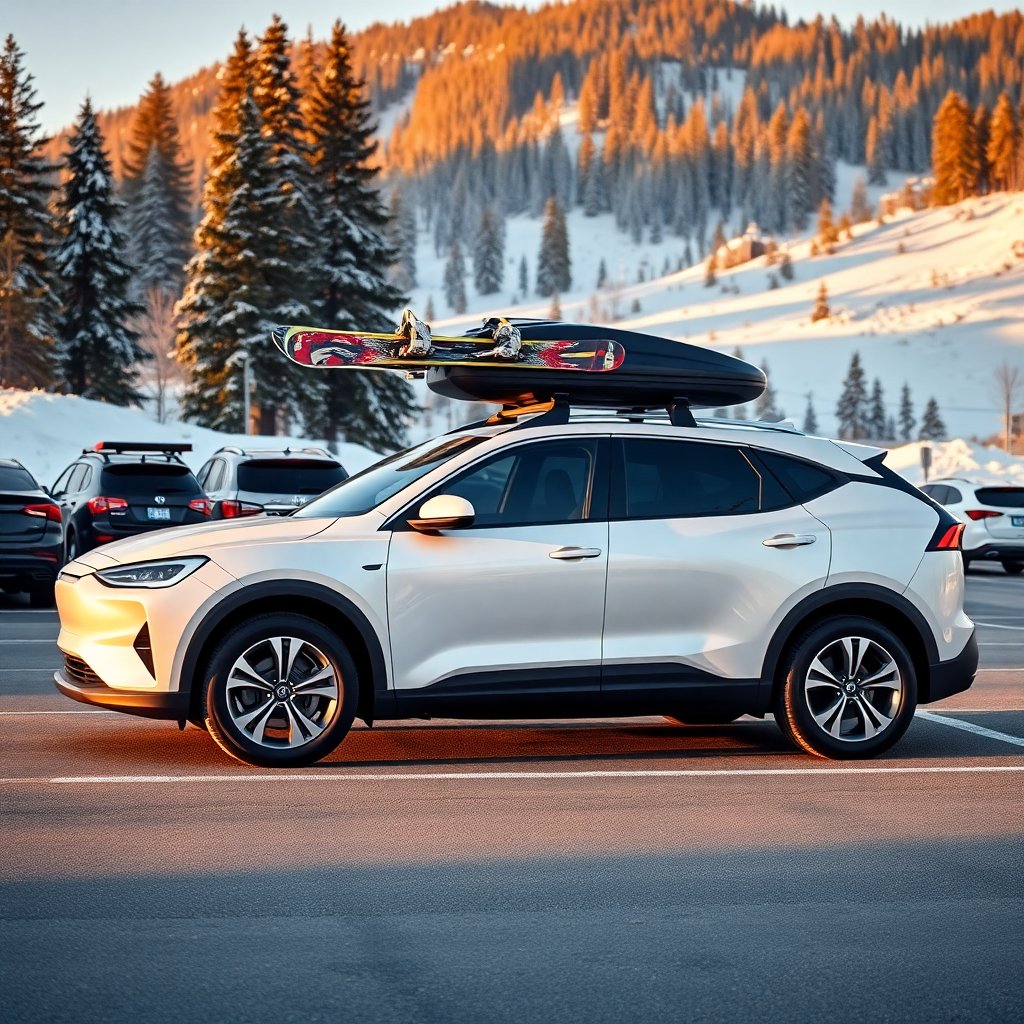
Ski season is a few weeks out in most of the northern US, and the question shows up in every Tesla owner group around now: where do the skis go? A Model Y swallows a surprising amount of gear inside, but four people plus four pairs of skis plus boots and bags is more than any compact crossover can hold without help. The Model 3 is tighter still.
The good news is that Tesla's flush roof and its official crossbar system work well with mainstream ski carriers and cargo boxes. The bad news is that anything on the roof costs range, and range is already lower in the cold. This guide walks through the options from cheapest and most efficient to most capable, with the trade-offs we would want to know before spending several hundred dollars.
Affiliate disclosure: some links below are Amazon affiliate links. If you buy through them we may earn a small commission at no extra cost to you. We only recommend gear types we would put on our own cars.
First: Do You Need a Rack at All?
Inside the car is free range. The Model Y's rear seats split 40/20/40, and the center pass-through lets two or three pairs of skis slide in from the trunk while two passengers ride in the outboard rear seats. Most skis up to roughly 170 to 175 cm fit diagonally in a Model Y with the center section folded. Snowboards are easier; they are shorter and lie flat.
What you need for the inside-carry approach:
- A padded ski bag or a pass-through ski sleeve so wet, sharp edges never touch the upholstery or headliner.
- A rubber cargo liner to catch meltwater and road salt. We compared options in our Tesla cargo area liner guide.
- A towel or boot tray for the frunk, which makes a great wet-boot locker.
→ Shop padded ski bags on Amazon
If you ski with one or two people, stop here. You will keep every mile of range and avoid the wind noise. Racks make sense once you are carrying a full car of people or longer freeride skis.
Option 1: Tesla Roof Rack Plus Clamp-Style Ski Carrier
Best for: families of four, frequent mountain trips, owners who also want a bike or cargo box later.
Tesla sells its own aero crossbar kit for the Model Y and Model 3. According to Tesla's official Model Y Roof Rack listing, the rack uses aluminum crossbars with T-slots and carries a load rating of 165 lb. That number is a dynamic (while-driving) rating and it covers everything on the bars, including the carrier itself, so subtract the weight of the carrier before you count skis. Always check your owner's manual for the figure that applies to your specific model and year, because the newer Model Y L and refreshed variants have their own listings.
Third-party bars from Thule and Yakima also fit, usually through a vehicle-specific fit kit that clamps into the glass-roof mounting points. Use the manufacturer's fit guide for your exact build year; the 2025 and later Model Y "Juniper" refresh changed some details, and a fit kit for the old car may not match.
Once you have bars, a clamp-style ski carrier is the efficient choice. These are the low, rubber-jawed carriers that hold skis flat:
- Thule SnowPack (Medium or Large): the default pick for most families. The medium holds up to four pairs of skis or two snowboards, the large holds up to six pairs. Lockable, push-button opening that works with gloves on.
- Yakima FatCat EVO: a similar design with a slider that pulls the carrier toward the side of the car so shorter people can reach it, which matters on a Model Y's roof height. Well-regarded for wide powder skis.
- Budget aluminum clamp carriers: they work, but check that the rubber jaws are deep enough for wide skis and that the lock cylinders are real.
→ Shop Thule SnowPack ski carriers on Amazon
→ Shop Yakima FatCat EVO on Amazon
Range penalty: low, as roof options go. Skis lie flat and present a small frontal area. Expect a few percent at highway speed, more in a crosswind or at 75-plus mph. Many owners report the bars alone add measurable wind noise, so take the bars off in summer if you do not use them.
Tip: Load skis tips facing backward. It reduces lift and lowers the chance of wind getting under the tips at speed.
Option 2: Roof Cargo Box
Best for: carrying skis plus boots, helmets, and duffels; road trips with a full cabin.
A ski-length cargo box turns the roof into a weatherproof, lockable trunk. The trade-off is drag. A box has a much larger frontal area than a flat carrier, and the range hit is real: independent tests on EVs commonly show double-digit percent losses at highway speed with a large box, and cold weather stacks on top of that. Read our breakdown of Tesla cold-weather range and charging before you plan a long mountain drive with a box on top.
What to look for in a Tesla-friendly box:
- Length of 200 cm or more if you want it to hold adult skis. Measure your longest pair.
- A low, tapered profile. Slimmer boxes, such as the Thule Motion XT and Yakima SkyBox families or the shallow "sport" variants of each, cost less range than tall, blunt boxes.
- Dual-side opening. You will not want to walk around a car in a slushy parking lot to grab one helmet.
- Rear-hatch clearance. The Model Y's powered liftgate swings up and back. Mount the box far enough forward that the open hatch does not hit it, and set a lower liftgate opening height in the car's settings as a safety margin.
- Weight. A big box can weigh 40 to 50 lb empty. Subtract that from the 165 lb rack rating and see what is left for cargo.
→ Shop slim ski-length roof cargo boxes on Amazon
Our take: a box is the most convenient option and the most expensive one, both up front and in range. If you only ski a handful of weekends per year, a clamp carrier plus inside storage is usually the better value.
Option 3: Hitch-Mounted Ski Carrier
Best for: Model Y owners who already have the factory tow hitch, or anyone who hates lifting skis overhead.
Teslas with the tow package have a 2-inch receiver, and several companies make hitch-mount ski and snowboard carriers, either as standalone units or as adapters that attach to an existing platform bike rack. The appeal is obvious: the load sits in the car's wake instead of in clean air on the roof, so the aerodynamic penalty is lower, and nothing goes above shoulder height.
Downsides to weigh:
- Road spray. Skis hanging behind the car collect slush and salt. A ski bag or a carrier with a cover helps, and so does rinsing edges after the trip.
- Rear camera and liftgate access. Most hitch carriers tilt away, but check before buying. Some block part of the backup camera view.
- Tongue weight and hitch class. Confirm the hitch rating in your owner's manual and stay well under it.
- Theft. Use a locking hitch pin.
→ Shop hitch-mount ski and snowboard carriers on Amazon
Option 4: Magnetic and Suction Carriers (Mostly Skip)
Magnetic ski racks were popular on steel-roofed cars for decades. They are a bad fit for most Teslas, because the roof is largely glass and the remaining panels are not reliably steel. Suction-cup carriers exist and some owners use them, but we do not recommend trusting a 60 mph load of sharp-edged skis to suction on a glass roof in sub-freezing temperatures. Get a rated crossbar system or carry the skis inside.
Glass Roof Rules That Actually Matter
- Never mount anything directly to the glass. Use the designated mounting points only.
- Respect the rating. The 165 lb figure on Tesla's rack listing covers everything on the bars. Snow and ice that build up on a box add weight you did not plan for.
- Torque to spec, then check again. Re-check rack tower torque after the first 50 miles and periodically through the season. Cold contracts metal.
- Clear snow before driving. A sheet of snow sliding off a box or the glass roof onto the car behind you is dangerous, and in some states it can get you a ticket.
- Pull the rack in spring. Bars left on year-round cost range on every commute.
Comparison Table
| Option | Approx. cost | Range impact | Capacity | Convenience | |---|---|---|---|---| | Inside the car + ski bag | Lowest | None | 2 to 3 pairs with 2 rear passengers | High for small groups | | Roof rack + clamp carrier | Mid | Low to moderate | 4 to 6 pairs | Good, overhead lift | | Roof rack + cargo box | Highest | Moderate to high | Skis + boots + bags | Highest | | Hitch ski carrier | Mid | Low | 4 to 6 pairs | Good, waist height, gets dirty |
Range Planning for a Ski Weekend
Mountain trips combine three range killers: cold temperatures, long climbs, and roof drag. A few habits help:
- Precondition the cabin and battery while still plugged in at home or at the hotel.
- Add a buffer. Plan to arrive at superchargers with more margin than you would in summer, roughly 20 percent instead of 10, especially with a box.
- Slow down a bit. Drag rises sharply with speed, and a roof load magnifies that. Dropping from 75 to 68 mph can recover a noticeable chunk of range.
- Use regen on the way down. Long descents return energy to the pack, so the drive home often uses less than the drive up.
For the rest of the cold-weather kit — ice scrapers safe for glass roofs, all-weather mats, and window covers — see our Tesla winter accessories guide.
Accessories That Make Ski Trips Easier
- Boot bags or a boot tray for the frunk. Keeps meltwater out of the cabin.
- A ski-edge-safe cargo liner with raised edges for the trunk.
- Locking cables for skis left on a carrier during lunch.
- A small brush and plastic scraper stored in the frunk for clearing the roof and box.
→ Shop ski boot bags on Amazon
Bottom Line
For most Tesla owners, the order of preference is simple. Carry skis inside if the group is small. Add Tesla or Thule/Yakima crossbars and a clamp-style carrier like the SnowPack or FatCat EVO if you need room for four people and their skis. Step up to a slim cargo box only if you need weatherproof space for boots and bags, and budget for the range penalty. If your car already has a hitch, a hitch carrier is the most efficient way to haul a full family's skis.
Whatever you choose, buy it now rather than the week of your first trip. Fit kits for specific model years sell out once the first big storm hits, and installing a rack in a cold driveway is no fun. Verify fit against your exact model and year, respect the load rating, and enjoy the drive up the mountain.
As an Amazon Associate we earn from qualifying purchases. This article contains affiliate links; if you buy through them we may earn a small commission at no additional cost to you.