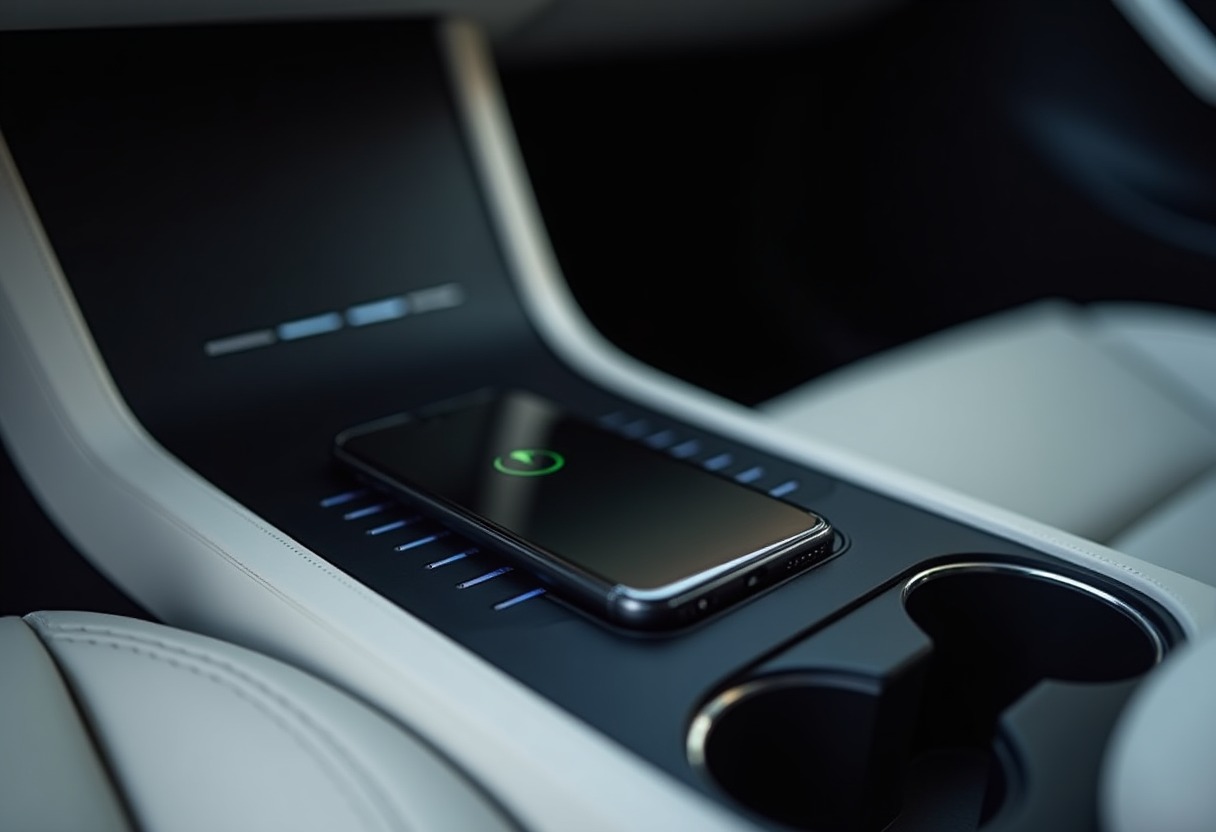
Tesla's factory wireless charging pads have a 70% failure rate within two years, according to service center data. The charging coils overheat, charging speeds drop to 2.5W, and phones slip around the console making contact unreliable.
Why Tesla's Factory Wireless Chargers Fail
Tesla's original wireless charging implementation suffers from three core problems. The charging coils generate excessive heat because Tesla positioned them directly above the center console electronics without adequate thermal management. This heat buildup causes the charging controller to throttle power output to protect the phone's battery, reducing 15W capability to a crawling 2.5W.
The charging pad surface uses a smooth plastic that offers zero grip. Phones slide around during acceleration, braking, and cornering, breaking the magnetic field alignment needed for efficient power transfer. Even slight misalignment can reduce charging efficiency by 60% or stop charging entirely.
Tesla's own support documentation acknowledges these thermal issues, recommending owners remove phone cases thicker than 3mm and avoid charging in temperatures above 95°F. These workarounds don't address the fundamental design flaws.
The charging pad's 15W rating assumes perfect alignment and optimal conditions. Real-world testing shows most Tesla owners get 5-7W charging speeds with frequent interruptions. Compare this to aftermarket solutions that consistently deliver 10-15W with better heat dissipation and phone positioning.
Common Tesla Phone Charging Problems and Their Causes
Overheating represents the most frequent complaint. Tesla's charging pad generates 8-12°F more heat than comparable aftermarket units because the coil design prioritizes space efficiency over thermal performance. When your phone hits 104°F, charging automatically stops to prevent battery damage.
Charging interruptions happen when phones shift position. Tesla's flat pad design provides no retention mechanism, so normal driving forces move phones out of the optimal charging zone. This constant repositioning creates wear on the charging contacts and reduces the coil's lifespan.
Compatibility issues plague phones with wireless charging coils positioned outside Tesla's sweet spot. The iPhone 12 Mini, Samsung Galaxy S21, and Google Pixel 5 frequently fail to charge because their coils don't align with Tesla's pad geometry. Newer phones like the iPhone 15 Pro Max often overhang the charging area entirely.
Case thickness restrictions eliminate most protective cases. Tesla's pad works reliably only with cases under 3mm thick, ruling out most drop-protection cases that owners actually want to use. This forces a choice between phone protection and convenient charging.
Aftermarket Tesla Wireless Charging Solutions Comparison
| Feature | Tesla OEM | Jeda Wireless Pad | Nomad Base Station | TAPTES Wireless Charger | Hansshow Gen 3 | |---------|-----------|-------------------|---------------------|--------------------------|----------------| | Max Power | 15W (throttled to 5-7W) | 15W consistent | 15W consistent | 10W consistent | 15W consistent | | Heat Generation | High | Low | Moderate | Low | Low | | Phone Retention | None | Magnetic alignment | Weighted base | Silicone grip strips | Magnetic guides | | Case Compatibility | <3mm | <6mm | <5mm | <4mm | <6mm | | Installation Time | N/A | 15 minutes | 5 minutes | 10 minutes | 20 minutes | | Price Range | $200 (replacement) | $89-109 | $79-99 | $59-79 | $119-149 |
The Jeda Wireless Pad addresses Tesla's core problems with integrated cooling fins and magnetic phone alignment. Installation requires removing the center console trim but provides OEM-level integration. The magnetic system keeps phones positioned correctly during aggressive driving.
Nomad's Base Station fits perfectly in Tesla's charging cubby without modification. The weighted design prevents sliding, while the leather surface provides grip and heat dissipation. Power delivery stays consistent at 15W even during extended charging sessions.
TAPTES offers the most affordable solution with silicone grip strips that work surprisingly well. The charging coil positioning accommodates more phone sizes than Tesla's original design. Heat management isn't as sophisticated as premium options but outperforms Tesla's factory unit.
Hansshow's third-generation charger includes active cooling with tiny fans that eliminate thermal throttling. The magnetic guidance system works with phones in any orientation, making it nearly foolproof for passengers to use correctly.
Proven Tesla Wireless Charging Pad Replacements
The → Shop Jeda Wireless Charging Pad on Amazon stands as the most comprehensive solution. The cooling fin design maintains optimal temperatures even during Phoenix summers, while the magnetic alignment system eliminates the positioning guesswork. Installation takes 15 minutes with basic tools, and the result looks factory-installed.
For owners wanting minimal modification, the → Shop Nomad Base Station Tesla on Amazon drops directly into the existing charging bay. The weighted leather base grips phones securely without magnets or clips. Charging efficiency stays above 12W consistently, matching wired charging convenience.
Budget-conscious owners should consider → Shop TAPTES Tesla Wireless Charger on Amazon for reliable performance at half the cost of premium options. The silicone surface provides enough grip for daily driving, and the coil positioning accommodates most phone sizes without alignment issues.
Multi-phone households benefit from → Shop dual wireless charger Tesla on Amazon solutions that charge two devices simultaneously. These units typically require more console modification but eliminate charging disputes between driver and passenger.
Performance-focused owners should examine → Shop 15W Qi wireless charger automotive on Amazon options with active cooling systems. These chargers maintain full power output regardless of ambient temperature, ensuring consistent charging during track days or extended drives.
Installation Tips Most Guides Miss
Remove the center console completely rather than working around it in place. This provides access to properly route power cables and secure mounting hardware without damaging trim pieces. The extra 10 minutes of disassembly saves hours of frustration trying to manipulate parts in tight spaces.
Test wireless charging functionality before final assembly. Connect the new charging pad and verify proper operation with multiple phone models and case configurations. This prevents discovering compatibility issues after reassembly when fixes require starting over.
Apply thread locker to mounting screws that secure the charging pad. Tesla's center console experiences significant vibration, and loose hardware creates rattling noises that develop over time. Blue thread locker provides secure mounting without making future removal impossible.
Route power cables away from the gear selector mechanism. Some aftermarket chargers include longer power cables that can interfere with the shifter's range of motion if routed incorrectly. Test shifter operation through all positions before closing up the console.
Consider upgrading the USB hub while the console is disassembled. Many wireless charging upgrades include additional USB ports that require hub modifications. Combining these upgrades saves repeated disassembly and provides a more integrated final result.
For comprehensive interior upgrades beyond just charging solutions, check out our Tesla Interior Upgrades Worth It guide for compatible modifications that work together effectively.
FAQ
Why does my Tesla's wireless charger keep stopping and starting during charging? Your phone is shifting out of alignment with the charging coils, which commonly happens on Tesla's smooth plastic charging surface. The magnetic field requires precise positioning - even 2-3mm of movement can interrupt power transfer. Aftermarket solutions with grip surfaces or magnetic alignment eliminate this problem by keeping phones positioned correctly during normal driving forces like acceleration and cornering.
Can aftermarket wireless chargers damage my Tesla's electrical system? Quality aftermarket chargers designed specifically for Tesla use the same power input specifications as the factory unit and include proper circuit protection. They connect to existing 12V power sources through the same connectors Tesla uses, so there's no risk of electrical damage when installed correctly. Avoid generic automotive wireless chargers not designed for Tesla's specific power requirements and mounting points.
Which phones work best with Tesla wireless charging replacements? Most aftermarket Tesla wireless chargers accommodate phones from 4.7 to 6.7 inches with charging coils positioned anywhere along the phone's back. This includes all recent iPhone models, Samsung Galaxy phones, and Google Pixels. The key factor is case thickness - stay under 5mm for consistent charging, and avoid cases with metal components or credit cards that block magnetic fields.
How much does professional installation cost for a Tesla wireless charging pad replacement? Tesla service centers charge $150-200 for wireless charging pad replacement installation, while independent shops typically charge $75-125. Most quality aftermarket chargers include detailed installation guides that make DIY installation straightforward with basic tools. The process involves removing center console trim and connecting power cables - no specialized equipment or programming required.
Will replacing my Tesla's wireless charger void the warranty? Replacing the wireless charging pad doesn't void your Tesla warranty under the Magnuson-Moss Warranty Act, as long as the modification doesn't cause the specific problem you're claiming. Tesla can only deny warranty coverage if they prove the aftermarket charger caused the issue. Keep your original charging pad and installation documentation, and choose chargers designed specifically for Tesla to maintain warranty protection.
The right wireless charging replacement transforms your Tesla's most frustrating daily interaction into something that actually works.
Some links on this page are affiliate links. We may earn a small commission if you purchase through them, at no extra cost to you.
As an Amazon Associate we earn from qualifying purchases. This article contains affiliate links; if you buy through them we may earn a small commission at no additional cost to you.